
Latest update:
NASA’s Curiosity is turning its robotic arm into a portable flashlight to photograph the red planet under a pitch-black sky



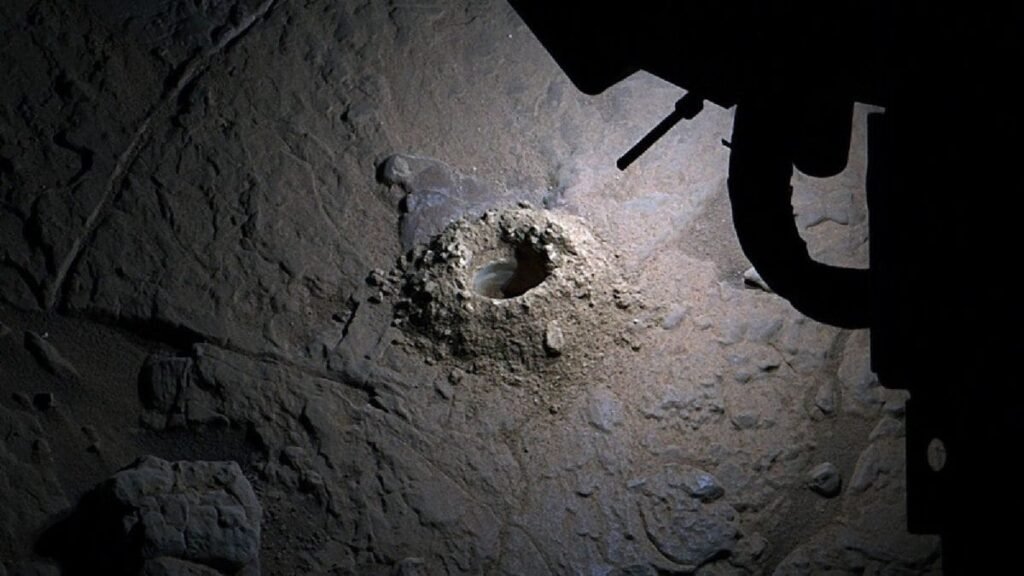
Using lights from the Mars Hand Lens Imager, Curiosity illuminated a freshly drilled crater and captured an unusual nighttime image to help scientists examine the geology of Mars. (Image: NASA/JPL-Caltech/MSSS)
NASA’s Curiosity rover captured a rare nighttime image of Mars, using tiny LEDs on its robotic arm to illuminate the red planet’s dark surface.
The unusual image was taken on December 6, 2025, during the 4,740th Martian day, or “sol,” of the Curiosity mission, and NASA shared it on its web page and social media. Night images from Mars are very uncommon because rovers typically rely on sunlight to take images.
To create the image, Curiosity used lights attached to a camera called the Mars Hand Lens Imager, or MAHLI, located at the end of its robotic arm. These LEDs act like little flashlights, illuminating a patch of land so another camera, the Mastcam on the rover’s “head,” can image it.
Scientists typically use MAHLI lights during the day to look into dark corners, such as the inside of drill holes or small openings on the rover. But their use at night is rare. Earlier in the mission, researchers attempted night photography to study the layers within the excavated rocks and better understand their composition.
The idea was revived after Curiosity drilled into a rock target dubbed Nevado Sajama on November 13, 2025. Engineers noted that the walls of the new drill hole are smoother than usual and might reveal hidden details if illuminated in the dark.
The hole was drilled in an area covered in unusual geological patterns known as box formations. These intersecting ridges stretch for miles and look like giant spider webs when viewed from orbit, making the area particularly interesting to scientists.
Curiosity has been exploring Mars since 2012, slowly climbing Mount Sharp and studying the planet’s ancient environment. The vehicle was built by NASA’s Jet Propulsion Laboratory in California, which manages the mission for NASA. The two cameras used for the image — Mastcam and MAHLI — were developed and operated by Malin Space Science Systems in San Diego.
Washington, D.C., United States of America (USA)
05 February 2026 at 02:50 IST
Read more