
Eid al-Fitr date difference: Every year when Eid al-Fitr approaches, a question once again arises for discussion: Why is Eid celebrated on different days in India, Saudi Arabia and other countries? Discussions start on social media, people mix up calendars, and sometimes confusion spreads. In fact, this issue is not just a matter of tradition, but an interesting mixture of astronomy, religious beliefs and local conditions. Although this process of seeing the moon is simple, it is equally complex. If you’ve ever wondered why the same festival has different dates, the answer is hidden in this whole story related to the moon.
Why does Eid depend on the sighting of the crescent?
The Islamic calendar, called the Hijri calendar, is based entirely on the lunar cycle. In this way, every month begins with the appearance of the new crescent. Eid is celebrated 29 or 30 days after Ramadan, when the Shawwal crescent is visible.
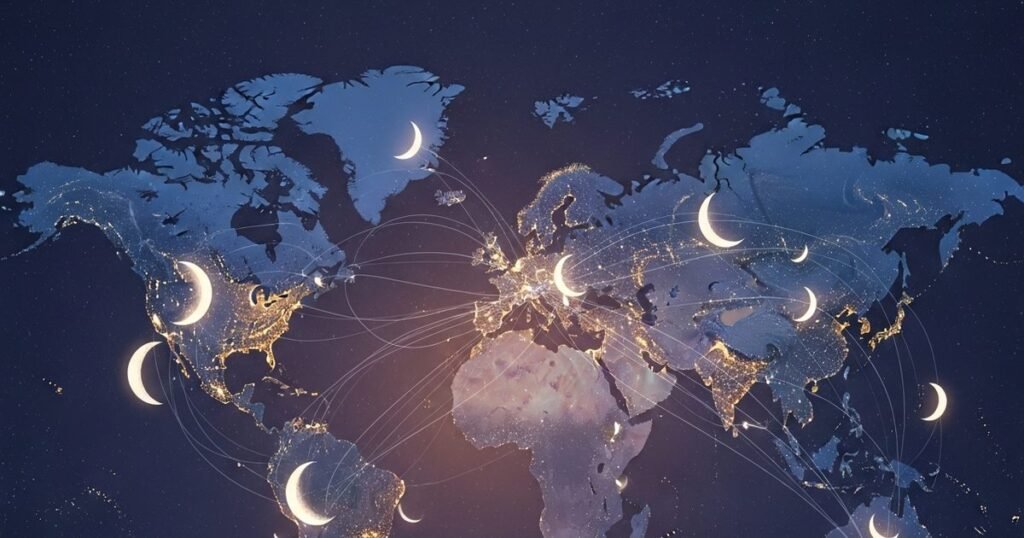
Why doesn’t the moon appear everywhere at the same time?
The Earth is spherical and each part of it receives sunlight at different times. For this reason, the visibility of the moon also varies depending on the place. For example, in Saudi Arabia the moon may be visible a few hours earlier than in India, while in India it may be visible the next day.
Religious beliefs and local decisions
Many Islamic scholars believe that it is necessary to see the moon from its local location. At the same time, some people also believe that if the crescent moon is sighted in one country, other countries can also celebrate the holiday on the same basis.
Different rules in different countries
Many Gulf countries also rely on astronomical calculations, while in countries such as India, Pakistan and Bangladesh, the traditional crescent sighting process is preferred. This is why there is a difference in history.
Balance between technology and tradition
Today, the Moon’s position can be determined in advance from telescope and satellite data. However, many societies consider seeing the moon with their own eyes as the ultimate sighting. This tradition has been going on for centuries and is closely linked to religious sentiments.
What does this mean for the general public?
Generally, for people the difference is only one day, but it affects preparations for festivals, holidays and social programmes. It even becomes a topic of joke in many families, “Which country comes Eid first?”
Unity in difference
There is no confusion or error behind the different date of the holiday, but rather it is a unique meeting of nature, science and faith. Although Eid is celebrated on different days in different countries, its joy and spirit remain the same everywhere.
(Disclaimer: The information and information contained in this article is based on general assumptions. Indian news18 has not confirmed these assumptions. Contact the relevant expert before implementing them.)