

Latest update:
The Orionid meteor shower, originating from Halley’s Comet, reaches its peak Tuesday night with up to 15 meteors per hour visible around the world. It is also possible to observe Comet SWAN and Comet Lemmon.

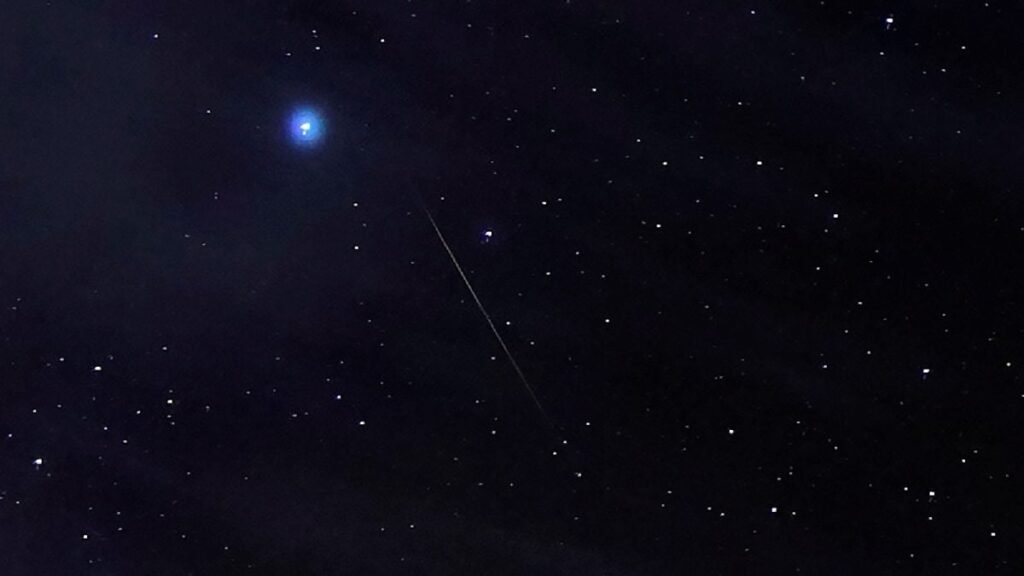
A meteor from the Orionids meteor shower, originating from the remnants of Halley’s Comet passing through Earth’s atmosphere, streams across the night sky past Halley’s Comet, above the San Rafael Swell outside Green River, Utah, USA. (Photo: Reuters)
Stargazers around the world have the best chance of seeing the annual Orionids meteor shower on Tuesday night if local weather conditions allow. Orion meteorites move very quickly, reaching a speed of about 66 kilometers per second. They streak across the sky in long, bright paths and originate from the famous Halley’s Comet as it follows its orbit around the sun. The comet itself passes by Earth approximately every 75 years, and the next visit is expected to be in the summer of 2061.
Orionids can be seen in the northern and southern hemispheres during the hours after midnight. The best way to watch it depends on which hemisphere you are in, according to a report by the broadcaster BBC. NASA suggests anyone hoping to see the shower lie on their back, with their feet facing southeast in the Northern Hemisphere or northeast in the Southern Hemisphere, and look up at the sky. According to the American Meteor Society, the only obstacles to seeing them are cloud cover and city lights.
Located about 97 kilometers above Earth, the Orionid meteor shower is often one of the most impressive meteor showers of the year, known for its speed and brightness.
As Earth passes through debris left by the comet, tiny particles, often no larger than grains of sand, burn up in the atmosphere, leaving bright streaks across the night sky. Some meteorites may appear faint, while larger ones produce bright trails. Sometimes, meteorites can overtake Venus; These are called fireballs.
Rare comets that can be seen
Sky watchers may also be able to catch a glimpse of Comet SWAN or Comet Lemmon, both of which are passing relatively close to Earth this week. Comet SWAN completes one orbit around the Sun every 22,554 years, while Comet Lemmon takes 1,350 years.
The radiant, or the point in the sky from which meteors appear to shoot, is the constellation Orion. Orion rises in the east after midnight, north of its red star Betelgeuse. To locate Orion, look for the line of three bright, closely aligned stars — Orion’s familiar belt.
The intensity of the show is measured by the zenith hour rate – the number of meteors visible per hour. During Orionids’ peak around October 22, observers may see approximately 15 meteors per hour, moving at 238,000 kilometers per hour.
For the best viewing experience, the broadcaster and space agencies suggest finding a dark place away from city lights with an open, unobstructed view of the sky. They also said that one should allow one’s eyes to adjust to the darkness and lie down and look toward Orion. There is no need for binoculars or a telescope, as the shower can be seen with the naked eye.

Shankianil Sarkar is Sub-Editor at News18. It covers international affairs, focusing on breaking news and in-depth analysis. He has more than seven years of experience during which he covered many…Read more
Shankianil Sarkar is Sub-Editor at News18. It covers international affairs, focusing on breaking news and in-depth analysis. He has more than seven years of experience during which he covered many… Read more
21 October 2025, 9:44 PM IST
Read more