
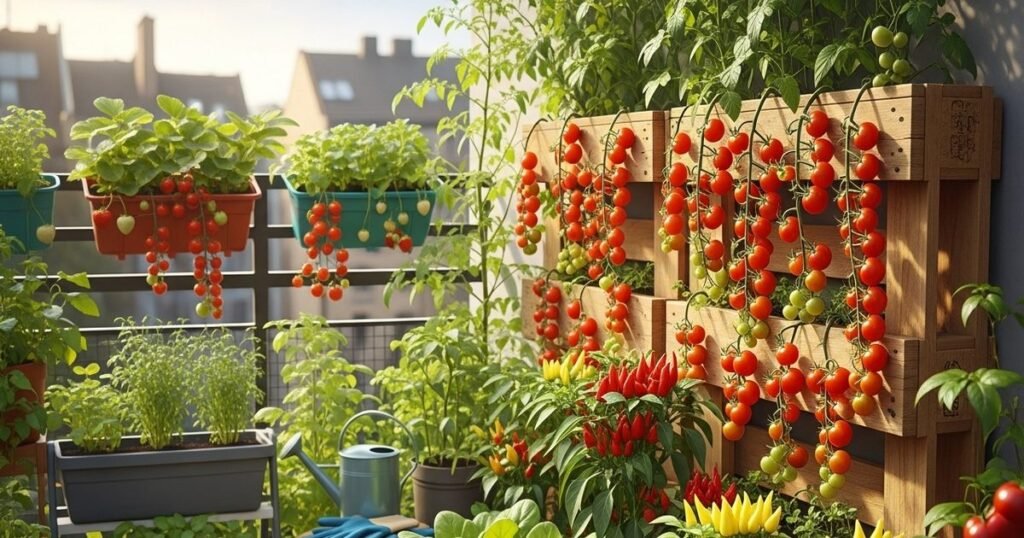
Small space vegetable gardening: Nowadays, homes in cities are becoming smaller, but everyone wants to eat fresh and organic vegetables. Be it a balcony, terrace or a small courtyard at home, if planned wisely, a good amount of vegetables can be grown even in a limited space. Many people think that a large garden is necessary for gardening, when the truth is that with the right pot, fertile soil, adequate sunlight and regular watering, even a small space can become green. In the past few years, the trend of urban gardening has increased rapidly and people are growing vegetables like tomatoes, chili peppers, coriander and spinach in their homes. If you are also thinking about growing vegetables in a small space, by adopting some easy strategies you can turn your small space into a productive kitchen garden.
How to make good use of small space
Gardening in small homes or apartments doesn’t mean your options are limited. Balcony railings, pots on the walls or containers placed on the balcony, all these places can be useful for growing vegetables. Nowadays, there are many types of vegetables available that have been developed specifically for small spaces. For example, pressed tomatoes, baby eggplants or pot-grown peppers. Their specialty is that the plants remain small but produce fruits in good quantity. Apart from this, the security of the small garden is also important. If animals or birds come around the house, it is best to put a light net or fence around the plants. This keeps the plants safe and hard work is not wasted.
Why does garden planning matter?
Proper use of sunlight
At least six to eight hours of direct sunlight daily is necessary for good growth of vegetables. Due to lack of sunlight, plants become weak and fruits do not ripen properly. However, some vegetables can grow in light shade as well. Such as lettuce, spinach, radishes, and broccoli. Therefore, if your balcony does not get full sunlight, it is wise to choose such crops.
The correct way to irrigate
Regular watering is very important for vegetables. Due to lack of water, plants are unable to develop properly. Experts believe that techniques such as drip or soaker irrigation are very effective in small gardens. Through these elements, water reaches the roots directly and losses are also reduced.
Soil quality
Good soil is the true strength of any garden. Soil rich in organic matter strengthens plant roots and also improves the taste of vegetables. Adding compost or compost made from kitchen waste to the home can greatly improve soil quality.
Choose vegetables suitable for small gardens
It is not possible to grow all vegetables in a limited space, hence it is important to choose the crop wisely. Experts advise growing these vegetables which are ready quickly and give good yield in less space. Such as tomatoes, chili peppers, brinjal, spinach and coriander.
If space is limited, it is better to choose varieties called ‘patio’, ‘dwarf’, ‘small’ or ‘compact’. Specially developed for small pots and limited space.
Benefits of growing vegetables with flowers
People often plant vegetables and flowers separately, but planting both together is also a smart way. The presence of flowers attracts bees and butterflies to the garden, which helps in pollinating the plants. This improves vegetable production. Besides, the garden also looks more beautiful.
Save space with vertical gardening
If space is very limited, allow vegetables to grow upwards. Vine vegetables such as cucumbers, beans and squash can be grown on trellises or supports. In this way, land space is saved and many types of plants can be grown in one place.
Lateral cultivation technique
Companion planting, i.e. the technique of planting trees together is also very useful in small gardens. For example, planting basil near tomatoes helps both plants grow better. Likewise, lettuce can be grown in the shade of tall plants. This makes better use of space.
The crop will be obtained by successive planting
Succession planting, i.e. planting seeds of a new crop every two to three weeks, is also a good method. As a result, instead of the entire crop being ready at one time, vegetables become available gradually throughout the season. This technique has proven to be very useful especially in crops such as beans, lettuce and zucchini.
A small house or limited space is no obstacle to gardening. With a little planning, proper plant selection, and modern gardening techniques, anyone can create a small but abundant vegetable garden in their home. This not only provides fresh and safe food but also provides enjoyment of gardening.