
Kanyakumari Temple: Located at the southern tip of India, Kanyakumari is not just a tourist destination but a living pilgrimage filled with faith, mystery and mythological stories. Once you get here, the confluence of the three seas, strong winds and the sound of temple bells gives a different feeling. Many people come here to watch the sunrise, while some come here to find their inner peace. But the biggest identity of this place is the Kumari Amman Temple located here which is considered as Shaktipeeth. A question often arises in people’s minds why this place was called ‘Kanya Kumari’? What is the story behind this, and why is the goddess worshiped here in virgin form? The answers to these questions are hidden not only in religion, but also in folklore and traditions. Let’s understand this whole story in detail.
Kanyakumari: Where the three seas and faith meet too
Kanyakumari, located at the far end of Tamil Nadu, is the place where the Indian Ocean, Arabian Sea and Bay of Bengal come together. As geographically distinct as this scene is, it is considered religiously important. The Kumari Amman temple located here is included among the Shaktipeeth, and it is believed that a portion of Sati fell here. The goddess is worshiped in the temple in the form of a young girl. What is interesting is that the form of the goddess here is not that of a mother or a wife, but rather that of an ascetic girl, which in itself creates a different identity.
The mythological story of Goddess Kanya Kumari
Panasour’s grace and terror
The story begins with a powerful demon named Banasur. By pleasing Lord Shiva, he received a boon as his death was possible only at the hands of a virgin girl. This blessing made him almost invincible, and he began to create terror in the Three Realms. The gods became worried. No one could confront him. Then all the gods approached Lord Vishnu and asked them for the solution.
Kanya Kumari emerged from the yagya
On the suggestion of Lord Vishnu, the gods performed a special yagya. From the fire of Yagya, a portion of Goddess Durga emerged in the form of a girl, whom we know today as Kanya Kumari. The Goddess expressed her desire to marry Shiva and for this she began strict penance. Pleased with his penance, Lord Shiva agreed to the marriage. But this is where the story takes a turn.
Narada’s deception and incomplete marriage
The gods were worried that if the goddess married who would kill Banasur? Then Devarshi Narad made a plan. When Lord Shiva was leaving for the wedding, Narad stopped him on the way in a way that ended the auspicious time for the marriage. Marriage cannot take place once the auspicious time has passed. It is believed that the goddess was angry about this, so she cursed all the wedding preparations, which turned into sand and shells. Even today, sand and shell shells are associated with this incident.
The end of Banasur and Devi’s decision
After not marrying, the goddess again engaged in penance. News of her beauty and power reached Banasur. He came to marry her but the goddess rejected him.
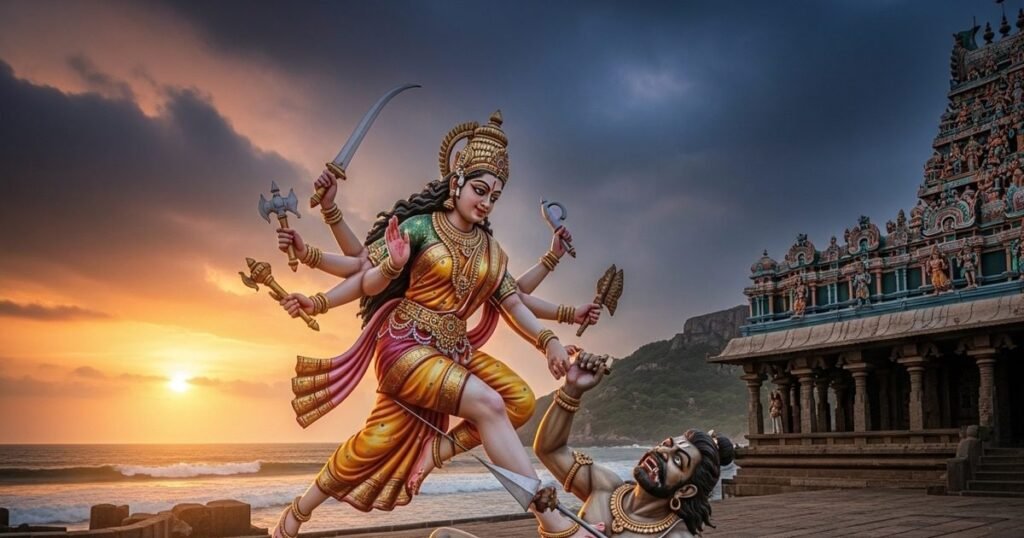
– When Panasaur started using power, the goddess fought with him. This war was extremely fierce, but in the end the goddess killed him. In this way the gods were freed from his terror.
– But after this whole incident, the Goddess decided to remain a virgin all her life, hence the name of this place – Kanya Kumari.
Religious importance of Kanyakumari temple
It is believed that this temple was established by Lord Parashuram. Devotees who come here not only get darshan but also bathe in the sea, which is considered holy. Locals call the goddess Bhagwati Amman or Kumari Amman. It is believed that if you pray here with a sincere heart, your desires will come true. People perform special puja here especially to remove obstacles in marriage and life.
The faith and the story are still alive
If you go to Kanyakumari, you will not only feel the smell of salt in the air, but you will also feel the depth of history and faith. The women sitting outside the temple, the puja dishes, the far-reaching sea – everything together tells a story that is thousands of years old, but still alive today.
(Disclaimer: The information and information contained in this article is based on general assumptions. Indian news18 has not confirmed these assumptions. Contact the relevant expert before implementing them.)