

Latest update:
For years, Pohlsepia mazonensis was thought to be the oldest known octopus, with what appeared to be eight tentacles, eyes and possibly ink.




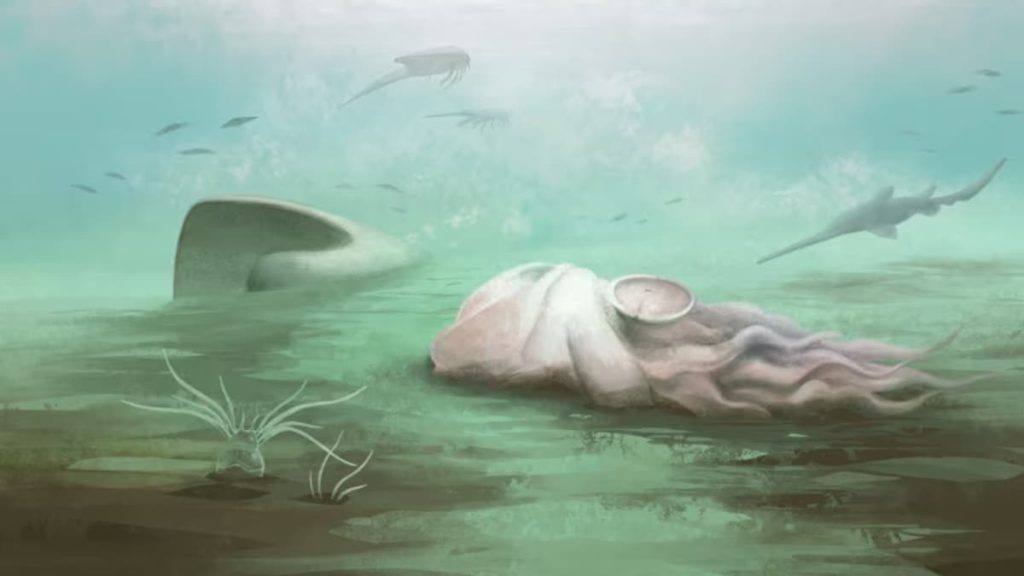
The fossil had decomposed so much before it could be preserved that it created a case of mistaken identity that lasted for more than a decade. (Image credits: University of Reading)
For more than 20 years, a fossil called Pohlsepia mazonensis has been celebrated as the world’s oldest known octopus, dating back nearly 300 million years. It even entered the Guinness Book of World Records, shaping how scientists understand the evolution of these intelligent sea creatures. But new research now reveals that this ancient marine animal has been misidentified all along.
The fossil was discovered at the Mason Creek site in Illinois, USA. For years, it was thought to be the oldest known octopus, with what appeared to be eight tentacles, eyes and perhaps an ink sac, features that closely match modern octopuses.
Using advanced synchrotron imaging, scientists were able to peer deeply into the fossil like never before. What they found changed everything: rows of tiny teeth that simply didn’t match those of an octopus.
Lead researcher Thomas Clements from the University of Reading explained: “We basically used a wide range of new analytical techniques to discover the anatomical features hidden within the rock. We were able to determine that it was not an octopus, but in fact a highly decomposed marine organism.”
The fossil had decomposed so much before it could be preserved that it created a case of mistaken identity that lasted for more than a decade.
Octopuses usually have fewer teeth in each row, but this fossil had 11 teeth, a clear sign that it belonged to a completely different group. Instead, researchers now say the creature is closely related to the nautilus, a marine animal that still exists today.
How have experts been misreading it for decades? The answer lies in decay.
Before fossilization, the animal’s body had already begun to break down, hiding key features like its shell. What remained looked soft and cyst-like, eerily resembling an octopus.
As one researcher explained, it essentially looked like a “bubble,” making it extremely difficult to interpret using ancient technology.
Earlier, this fossil indicated that octopuses existed hundreds of millions of years earlier than previously thought. Now, scientists believe that true octopuses may have evolved later, perhaps during the Jurassic period.
11 April 2026 at 01:09 IST
Read more