
Preserving food without a refrigerator: Nowadays, it seems almost impossible to imagine a kitchen without a refrigerator. In most homes, refrigerators are relied upon to preserve the safety of vegetables, milk, fruits, and leftovers. But even today, millions of people in many parts of the world keep their food safe without refrigerators and electricity. From the dry regions of Africa to Rajasthan, the Himalayas and rural India, many societies have for centuries adopted methods that keep food from spoiling for a long time. What distinguishes these methods is that they do not require electricity or modern machines.
People maintain food safety using nature, weather and traditional knowledge. This is not just a matter of antiquity, but even today these techniques are used in many places. From these things we learn that maintaining food safety does not depend only on machines, but that understanding and coordination with nature is no less important.
Lime pot: natural clay pot
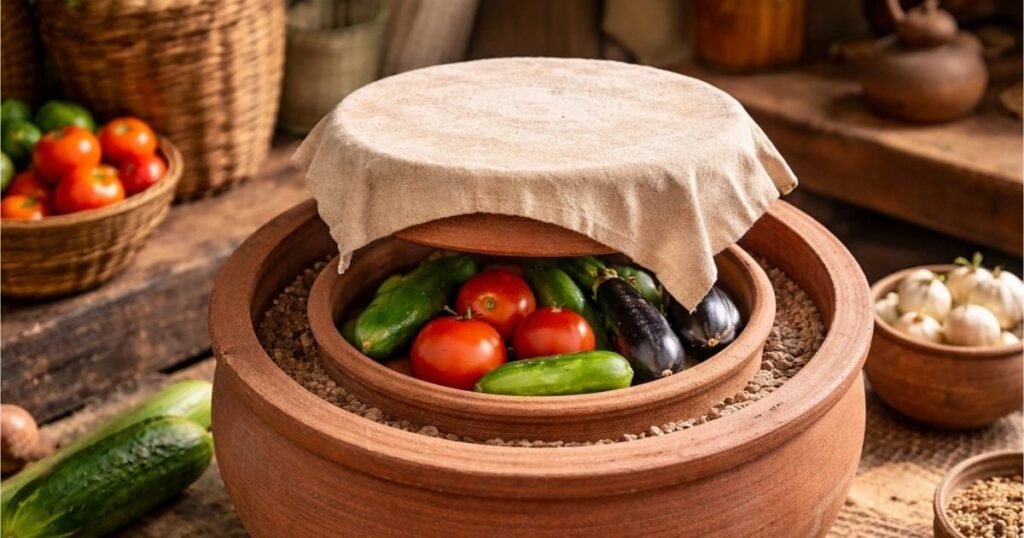
In many parts of Africa and the Middle East, a special type of pottery called a lime pot is used. It is also called a natural refrigerator. In this case, a small pot is placed inside a larger clay pot and the space between them is filled with wet sand. A damp cloth is covered on top. As the water dries slowly, it draws the heat in and keeps the cold inside the container. This way, vegetables, fruits, milk and cooked foods can be kept safe for a day or two. This method works very well in dry and hot areas.
Hang a basket over running water
In mountainous regions such as Himachal Pradesh and Uttarakhand, many families use natural springs and running water. People there keep food items in baskets or pots and hang them over the flowing water. The coldness of the water prevents the food from spoiling quickly. Running water regulates the temperature and reduces the chance of bacteria growth. In addition, using a mesh basket also provides air circulation and also provides protection from insects.
Protect food from salt and sunlight
Before the advent of refrigerators, people used salt and sunlight to preserve food for a long time. Fish, meat, and some vegetables were salted and dried in the sun. This reduces the moisture in it and the food does not spoil as quickly. Even today this method is used in Kerala, Tamil Nadu, Ladakh and many areas of northeastern India. For example, if raw mango pieces are dried in the sun after applying salt, they remain safe for several months and also enhance the taste of the food.
Keep food cold in crockery
Even today, in many rural areas of India, water and food are kept in clay pots. Crockery keeps its cool naturally. In many villages of Gujarat and Madhya Pradesh, people keep water, milk and even cooked rice in clay pots. If these containers are kept in a shady place and covered with a bag or a damp cloth, the items inside will stay cool longer.
Underground storage
In Kashmir, Nepal and cold mountainous areas, people preserve vegetables and grains by making small holes underground. The temperature inside the ground remains constant, so the food does not spoil quickly. In this way potatoes, carrots, onions and many grains can be preserved for a long time. Some people still use dirt pits in their yard.
Natural fermentation
In many Himalayan regions, the fermentation method is very popular for food preservation. For example, ghandruk, senki and many types of fermented vegetables. In this process, the vegetables are preserved with salt and spices, and after some time, natural fermentation begins. As a result, the food remains safe for a long time and nutrition also increases. These nutrients are also good for the stomach.
Preserving vegetables in ash and peels
A unique method is being adopted in rural areas of Maharashtra and Odisha. There people keep root vegetables such as ginger, turmeric, garlic and sweet potatoes buried in dry ash and peel. Ash absorbs moisture and keeps insects away as well. This keeps the vegetables safe for a long time.