
Natural sweet banana: Fruits are an important part of our daily diet, and among them bananas are the most consumed fruit. People often like to eat bananas in the morning for breakfast, after exercise, or to get quick energy. The potassium, fiber and many essential nutrients present in it help in giving strength to the body, but nowadays it is not right to consider every banana available in the market as completely natural. Often, to sell fruits quickly, they are cooked with chemicals, which makes them look yellow and attractive on the outside but not useful on the inside. Many people buy bananas without even paying attention to the color, only to later discover that they do not taste good or do not have the expected natural sweetness.
This is why it is important to pay attention to some small things while buying bananas. If you know the right signs, you can easily understand whether the banana is naturally ripe or has been ripened quickly using chemicals. The special thing is that this can be appreciated by looking at the color of the banana stem, its smell and the texture of the peel.
1. Leg color gives the biggest clue
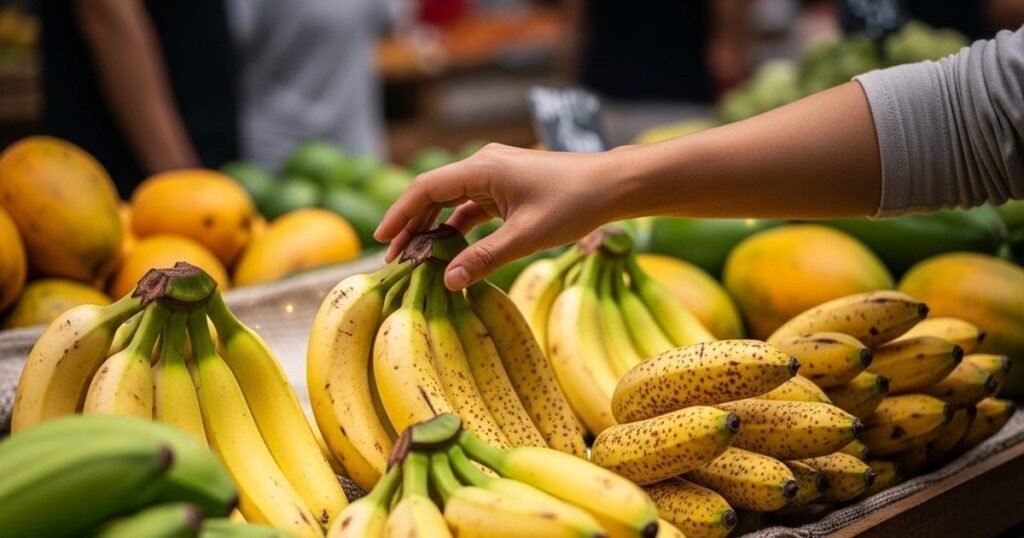
The easiest way to identify a banana is to look at its stem. The stem of a ripe banana naturally appears light yellow, brown, or slightly black. This means that the banana has gradually ripened after coming down from the tree. If the banana stem appears green and the rest is yellow, chemicals may have been used to ripen it quickly. Such bananas look good, but have less natural sweetness.
2. You can identify bananas even by looking at their color.
Many people believe that the brighter the yellow color of a banana, the better, but in reality, a bright yellow color can sometimes be a sign of artificial ripeness. Ripe bananas are naturally dark yellow in color with light brown or black spots. This is completely normal and is a sign that the banana is about to get sweet.
3. Touch and vision are also important
While buying bananas, one should press them lightly and examine them. Naturally ripe bananas are a little soft, if the banana is too hard, it may be immature. However, if they are too soft, they can spoil quickly. A suitable banana is one that feels slightly soft when pressed but is not mushy at all.
4. You can also tell by smell
Naturally ripe bananas have a slightly sweet and fresh aroma. When you bring such a banana near you, you feel the natural aroma of the fruit. While bananas cooked with chemicals often do not have this smell. Sometimes it has a weird or slight artificial smell. If the banana looks good but has no smell, it’s best to be a little careful.
5. The presence of spots on the peel is a good sign
Many people do not buy bananas that have black or brown spots on their peel, but these spots actually indicate that the banana is overripe. These are often called sugar stains. When bananas become fully ripe, their natural sugar content increases, which is why small spots appear on the peel. Such bananas are generally sweeter.
6. Beware of bananas that look too perfect
If all the bananas look the same bright yellow color and have no spots or blemishes, then some attention is needed. This appearance is often seen in fruits cooked with chemicals. Natural fruits often vary slightly in size and color, so slight variations are normal.