
Latest update:
Ancient Summer Lifestyle: Have you ever wondered how people lived in such scorching heat in ancient times, when there were no air conditioners or fans in homes? The fact is that people in ancient times kept their homes cooler than today. People never got sick like today. They knew better than us how to deal with this scorching heat. Let’s find out the five ways to live in summer that serve as a lesson for us even today.
Life before air conditioning, fan.
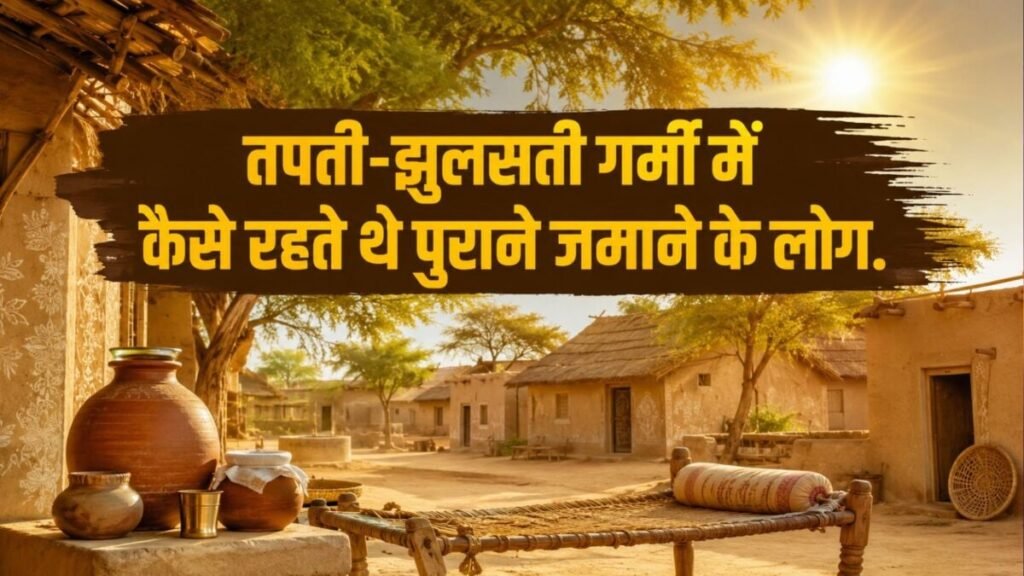
Old summer lifestyle: Today, in light of this extreme heat, we remain stuck in the air conditioners of our homes and offices all day and night. When we go out, there is a car with air conditioning, and when we get in, there is a room with air conditioning, but just imagine what people would have done a hundred years ago to escape this scorching heat. There was no air conditioning and no fan at that time. No one even had a permanent home. Some people have permanent homes. Most of the rest of the people had kutcha houses that were built in several ways. But in these absences there was a strange magic, thanks to which people in the past kept their homes cool without air conditioners in a better way than us. Their water also remained cold. Old people used to do many things to avoid such extreme heat, which made their house always cold. Among these methods, we know about 5 methods.
1. Kucha House-In ancient times most houses were kucha. This means that the wall was made of clay, and its roof was made of straw or grass. Different things were used for roofs in different places but the technology was almost the same. A combined effort between science and nature has worked on this matter. In fact, natural objects such as soil, straw, dry grass and bamboo are poor conductors of heat. Therefore, these things were used to stop the scorching heat of the sun. Nowadays, modern concrete surfaces do the opposite. They absorb the sun’s heat and throw it inside the house. There are millions of tiny air pockets within the structure of thatch or grass roofs. Air is a very poor conductor of heat. This means that it acts as a natural insulator and creates a thermal barrier. The most special thing is that the thick mud walls of the kutcha houses absorb the cold during the night and slowly release it during the day. In addition, the evaporation of light moisture in the soil kept the temperature inside the house several degrees lower than outside. In ancient times, when few homes had electric fans, people lived in harmony with nature.
2. The floor and ceiling are made of limestone- In ancient times, only a few people had permanent homes. Brick and limestone were widely used in these. At first their homes were open. This means there is enough space for air to flow around the house. Limestone was used in the floors and roofs of these houses. Limestone is an excellent natural heat insulator, as it absorbs heat from the outside and does not allow it to enter the interior of the house like concrete. Lime floors and surfaces have the property of absorbing moisture from the atmosphere and evaporating it slowly when the temperature rises. This process creates natural cooling within the home in the same way that a clay pot keeps water cold. Apart from that, the walls of these houses were thicker than modern walls which served as thermal mass. These walls would trap intense sunlight and heat throughout the day, and it would take several hours for them to reach the room. At night, when the outside temperature drops, these walls release the heat of the day outside and absorb the coolness of the night inside. The roofs of these houses were very high to allow air to enter. Large skylights were also provided directly under the roofs, and windows were provided in the walls. According to the laws of science, hot air always becomes lighter and rises upward. That is, when hot air begins to accumulate in the house, it will exit through high skylights and cold air will constantly enter through the windows to replace it. This is a great example of thermal ventilation.
3. Support pond and peepal tree-In ancient times, people usually got together in their free time. That is, a group of people lived and talked together under a social system. These were usually places where there was water somewhere. These people used to gather under the shade of peepal and banyan trees on the banks of rivers, ponds, lakes, etc., and there they would talk and play. The peepal or banyan tree absorbs carbohydrates in the hot sun and releases oxygen. For this reason, a naturally cool environment exists in the shade of these trees. But when there is a water connection nearby, when the wind carrying that water hits the peepal tree, a nice cool breeze comes out of it. This cold air was so natural that no air conditioner would work that way. In this way, people in ancient times were so in harmony with nature that they did not need air conditioning.
4. Rest in the afternoon-When the heat reaches extreme levels, there is usually a curfew in the afternoon. People did not go out during this scorching summer. There was no special work at this time. People lived in their homes or under the shade of a tree. In ancient times, people usually took a rest in the afternoon. At this time he slept for a while. So the roads will be completely empty in the afternoon. People would finish work early in the morning and socialize after sunset in the evening.
5. Ways to keep the body cool-In ancient times, people used many natural methods to keep the body cool. In those times there were no wrong eating habits like today. People always eat freshly cooked food at home. He consumed more seasonal fruits and vegetables in the summer. The water was kept in an earthen pot in which the cold water remained due to osmosis. Used to consume more green vegetables. In summer, fruits that contain a lot of water abound. Fruits like watermelon, watermelon, cucumber, tomato, patia, grape, lychee, mango etc. were widely consumed. The food included sattu, um panna, yoghurt, onions and wood apple juice which did not allow the internal body temperature to increase. By taking all these measures, the scorching heat had no effect on them.
About the author

In a career spanning over 18 years, Lakshmi Narayan has worked at reputed organizations like DD News, Outlook, Nai Duniya, Dainik Jagran and Hindustan. Various issues of contemporary topics, politics, society…Read more