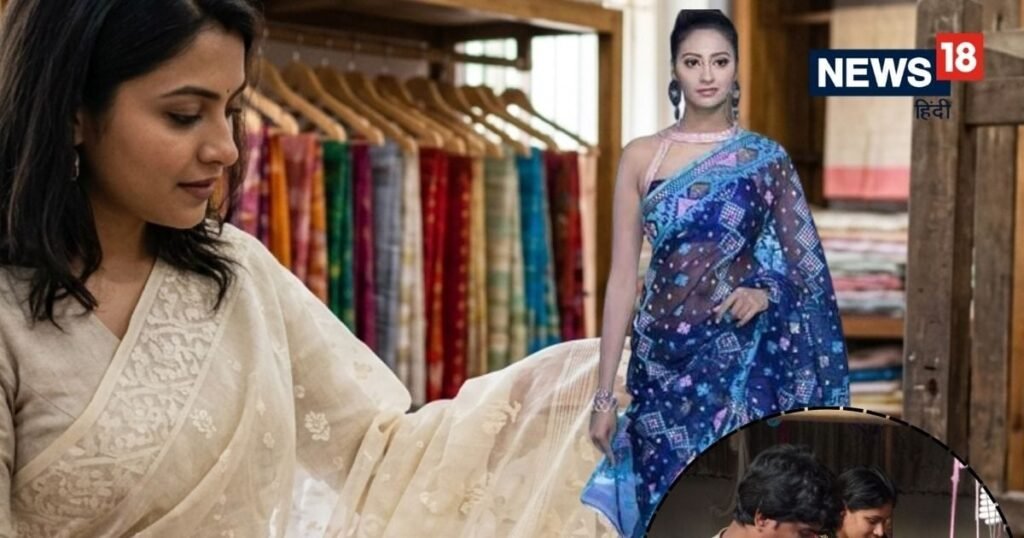
Bengal Jamdani Saree: Jamdani, the velvet heritage of Bengal, is not just a sari, but a glorious history woven from the threads. Called “air woven” due to its sheer texture and stunning texture, this art has become an important part of modern fashion and sustainable lifestyle. From the royal patronage of the Mughals to today’s global rampage, Jamdani’s madness lies in its unparalleled prowess and cultural depth. Not only is this craft the backbone of Bengal’s rural economy, it is also a shining facet of the global identity of Indian handicrafts.
Why does Sahar Al Jamdani appear again in the global market?
Jamdani has become very popular among young people.
The backbone of the rural economy
According to experts in the handloom sector, the demand for jamdani is witnessing an annual increase ranging between 15-20%. Now young artisans are also joining this art in the weavers’ groups of West Bengal. Digital India and e-commerce platforms have connected weavers directly with global buyers, reducing the role of middlemen and improving the income of artisans.
GI tag and purity determination
As the jamdani craze increased, there was also a flood of fake (machine-made) sarees in the market. However, the GI (Geographical Indication) tag that ‘West Bengal Jamdani’ received gave it a legal shield of protection. Buyers now invest by looking at the ‘handloom mark’ and GI logo on the corners of the saree, thus preserving the authenticity of this heritage.
Sustainable fashion: the first choice for modern women
Today’s generation is leaving ‘fast fashion’ and moving towards ‘sustainable clothing’. In such a situation, Jamdani became very popular among the youth. It is handwoven from completely natural threads (cotton and silk), drawn in this groove. Jamdani is now seen as a “status symbol” even in celebrity fashion and red carpet.
Experiments are also visible with technology
Today, Jamdani is not limited to only white and gold colors. Designers are now conducting many experiments with it. Jamdani motifs are now used in Indo-western jackets, scarves and gowns as well. Colors like lavender, mint green and coral have made it very popular among the younger generation.
The challenges are no less
Despite all this craziness, the hard work (600 to 800 hours) required to create an authentic jamdani is quite a challenge. To retain the new generation of weavers in the profession, the government is focusing on “skill development” and “soft loan schemes”.
How to recognize the real Jamdani?
The real Jamdani is identified by its “back side”. Since it is made by threading it during the weaving itself, no hanging or cut (cut) thread will be found on its back side. It looks completely smooth and identical from both sides.
In this way, it can be said that art connected to the roots never grows old. Today, this heritage of Bengal is not only a cultural pride of the country but also a fine example of ‘Made in India’.